Why Breathing Helps Children Manage Stress
The Science Behind Butterfly Breathing
Breathing is something we do automatically every day, yet it plays an important role in how we feel, think, and respond to stress.
For children and teenagers, strong emotions such as anxiety, frustration, or overwhelm can make breathing faster and shallower. When this happens, the body may remain in a state of tension, making it harder for young people to calm down and focus.
Learning simple breathing techniques can help children slow down their breathing and support emotional regulation.
One of the easiest ways to introduce this idea is through playful exercises like Butterfly Breathing.
How Breathing Affects the Body
Breathing is closely connected to the nervous system (the system that controls how the body reacts to stress and relaxation).
When we are stressed, the body activates what scientists call the sympathetic nervous system, often known as the “fight-or-flight” response. This causes faster breathing, increased heart rate, and physical tension.
Slow, deep breathing can help activate the parasympathetic nervous system, which is responsible for calming the body.
Research shows that diaphragmatic breathing, also called deep belly breathing, can support this calming process.
The diaphragm, a large muscle involved in breathing, performs around 80% of the body’s breathing work. When breathing is slow and deep, the diaphragm moves more effectively, helping the body relax and regulate important functions such as heart rate and blood pressure.
Studies also suggest that breathing exercises can help reduce stress, improve emotional well-being, and even support better concentration and learning outcomes in children and adolescents.
In some research studies involving young people, breathing exercises and related relaxation techniques were linked to improvements in:
- stress levels
- emotional wellbeing
- school performance
- family relationships
These findings highlight how simple breathing practices can support both mental and physical health.
Why Breathing Exercises Help Children
Children are still learning how to recognize and manage their emotions. Because of this, strong feelings can sometimes feel overwhelming.
Breathing exercises provide a simple and accessible tool children can use when they feel nervous, upset, or overstimulated.
They help children:
- slow down when emotions feel intense
• focus their attention
• reconnect with their bodies
• develop healthy self-regulation skills
When introduced in a positive and engaging way, breathing exercises can become a natural part of everyday routines.
Butterfly Breathing: A Simple Technique for Children
One breathing exercise used in the EMBRACE project is called Butterfly Breathing.
This technique helps children practice slow breathing using imagination and movement.
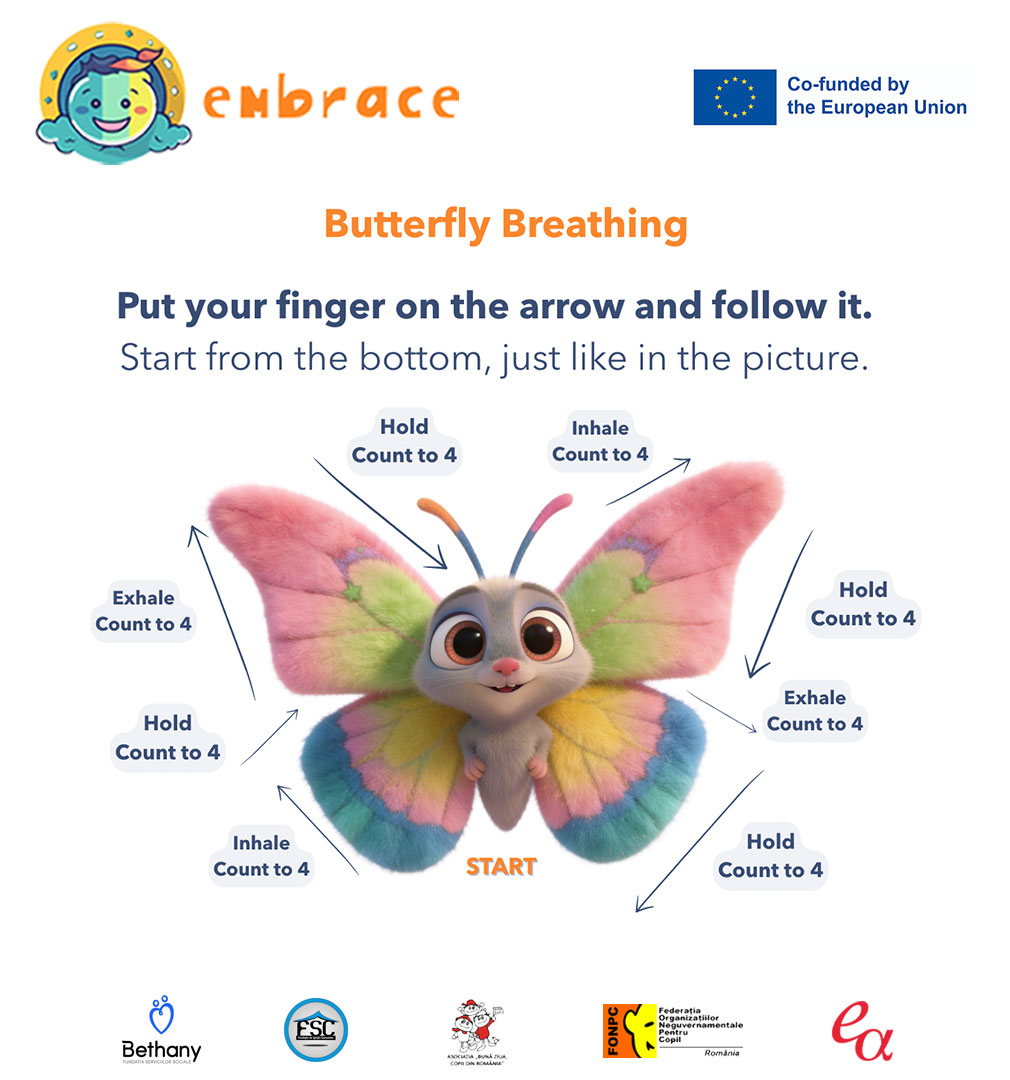
Here’s how it works using the image:
🦋 Start at the bottom of the butterfly and move clockwise to the right.
- Inhale – count to 4
- Hold – count to 4
- Exhale – count to 4
- Hold – count to 4
Repeating this exercise for several breaths can help children slow their breathing and relax their bodies.
Because the exercise uses a simple visual image, it is especially helpful for younger children who may find abstract explanations about emotions more difficult to understand.
How the EMBRACE Project Uses Breathing Techniques
The EMBRACE project promotes emotional literacy and resilience in children and teenagers through educational activities designed for schools.
Breathing exercises are included as part of these learning modules.
In elementary school activities, educators introduce techniques like Butterfly Breathing through playful exercises that help children understand how breathing affects their feelings.
In middle school modules, students learn more about how breathing techniques can help calm the nervous system and support emotional balance during stressful moments.
By practicing these techniques regularly, young people can develop practical tools they can use throughout their lives.
Small Tools Can Make a Big Difference
Managing emotions is an important life skill that develops over time. Simple practices like breathing exercises can give children a starting point for understanding how their bodies and emotions are connected.
Butterfly Breathing is a reminder that sometimes the most effective tools for emotional well-being are also the simplest.
With regular practice, breathing techniques can help children feel calmer, more focused, and better prepared to handle everyday challenges.
Funding Agency: EACEA – European Education and Culture Executive Agency
Learn more about EMBRACE: embrace-future.eu