EMBRACE Regional Conference – what happens when students, teachers, policymakers, psychologists, and parents are in the same room
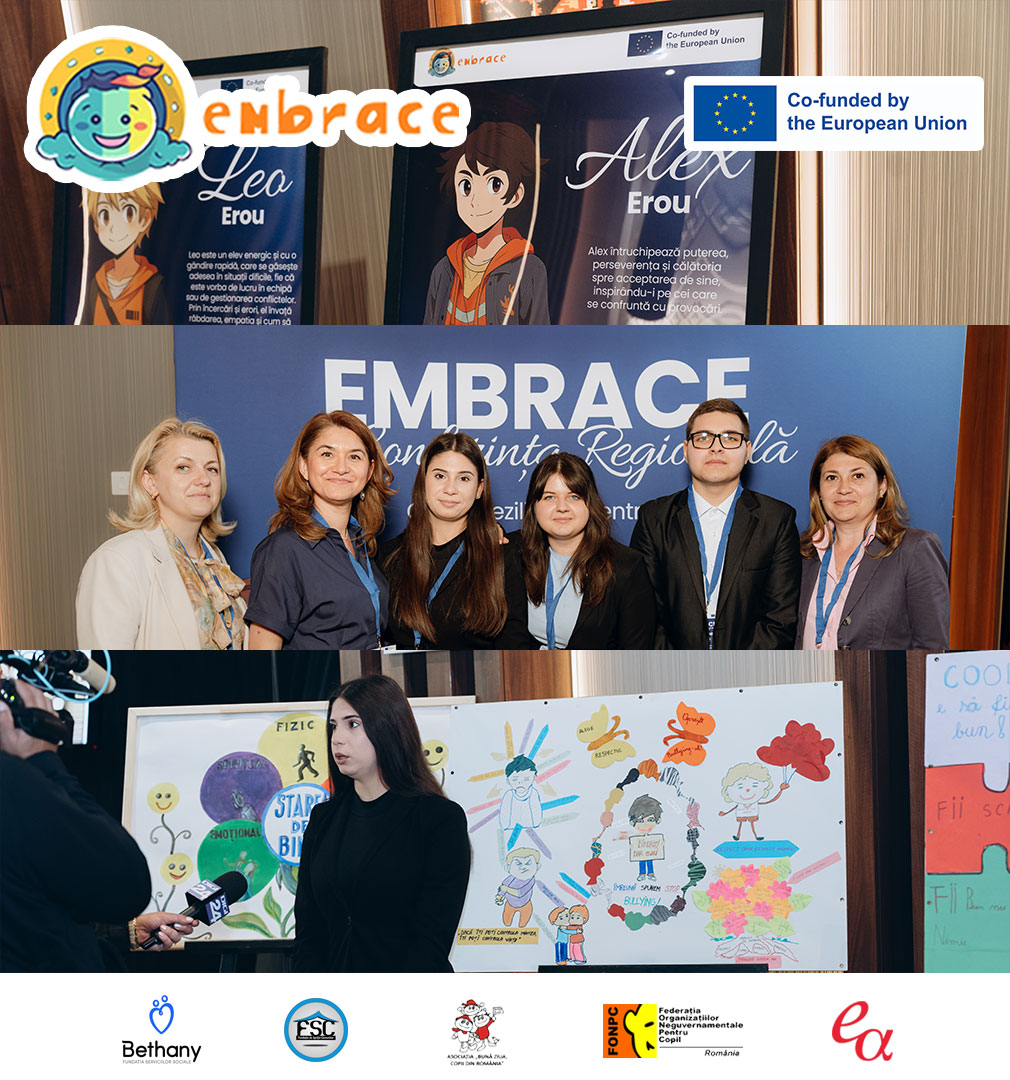
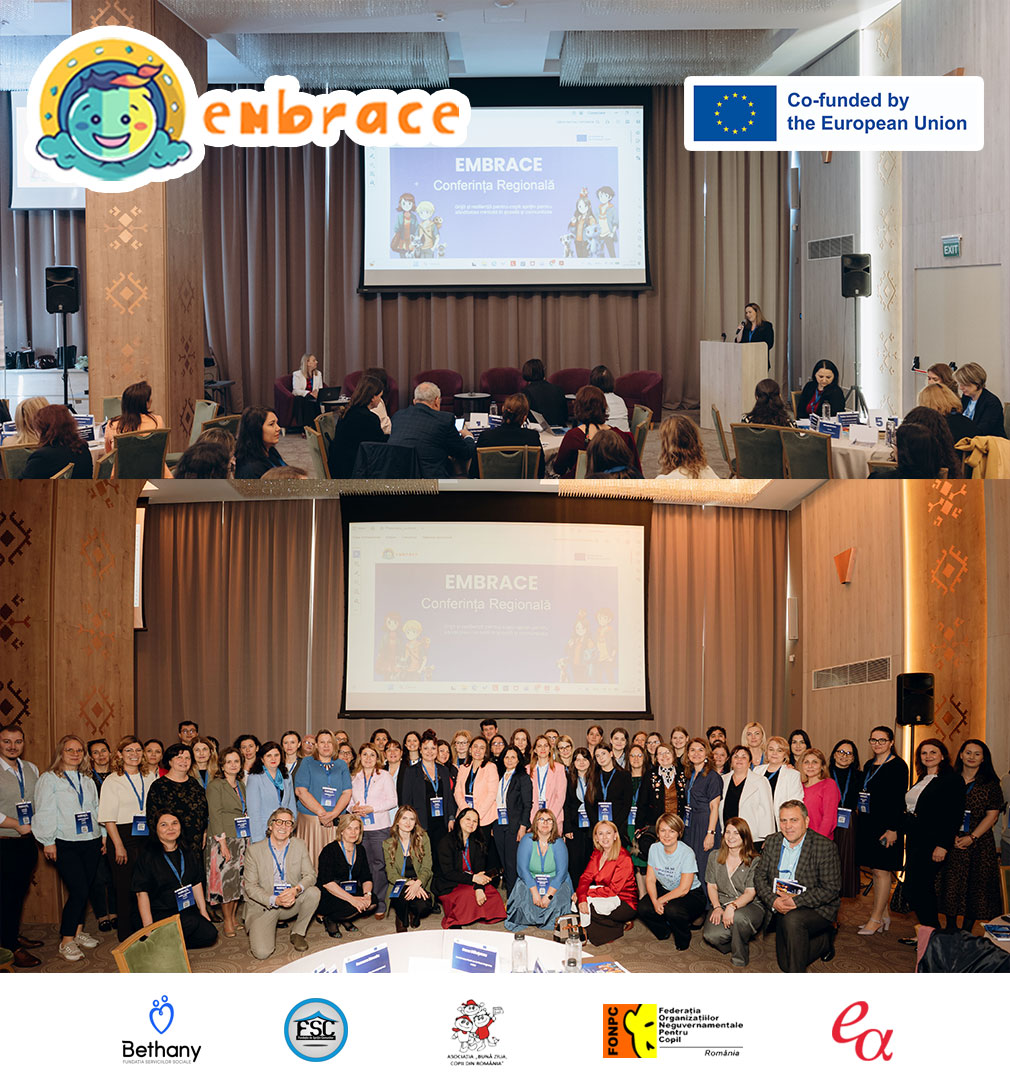
On May 14, 2026, at Hotel Unirea in Iași, Romania, more than 100 specialists from education, mental health, child protection, academia, and the nonprofit sector gathered at the EMBRACE Regional Conference to address one of the most urgent issues facing the country: the emotional well-being of Romanian children.
Policymakers, researchers, psychologists, teachers, organizational leaders, and, perhaps most importantly, young people all took the floor. What came out of that day was not just an event. It was a clear picture of a systemic crisis and, at the same time, of solutions that already exist and are waiting to be recognized and scaled.
What We Already Know and Why It’s Not Enough
Data presented by UNICEF Romania, drawn from a study of more than 1,800 middle school students and 100 teachers, paint a troubling picture:
- 1 in 4 students is at risk of experiencing a mental health problem.
- One-third of children report frequent worry and anxiety.
- 1 in 4 students has thoughts or behaviors related to self-harm.
- Children spend an average of 4 hours online per day and 7 hours on weekends, compared to the recommended 1–2 hours.
- The risk of mental health problems is higher than the European average.
These figures are compounded by the lasting effects of the pandemic: depression, social isolation, and excessive technology use have increased significantly since COVID-19, among both students and parents. Romania has valuable laws and initiatives – but, as Member of Parliament Corina Atanasiu emphasized, it lacks the strategy and institutional capacity to turn data into real solutions. The country has more than 544 laws related to public information access, research is being conducted, but there is no strategy to translate that data into action.
What Schools Can Do and Where the System Falls Short
Teachers remain the first line of observation of students’ emotional states. According to OECD data, 81% of teachers say they can support students’ emotional development – higher than the 73% average for the general school population. And yet, 87% acknowledge they lack the emotional competencies to do so effectively.
“Teachers cannot become psychotherapists. They need to learn to observe without labeling, to listen without minimizing, and to create safety.” – Roxana Mihai, Psychologist, Bethany Social Services Foundation.
“Teachers need emotional literacy for themselves – they cannot give children what they don’t have.” – panel note.
What schools can do:
- Teachers can use simple tools – the emotions thermometer, the skills wheel – to observe and refer, not to treat.
- School counselors can become facilitators of the relationship between the school, the child, and the family.
- School principals can set the tone for organizational culture and integrate the socio-emotional approach systemically, not as a standalone program.
Where the system breaks down:
- CJRAE Iași (the County Center for Educational Resources and Assistance) operates with 135 school counselors and 84 speech therapists – far below actual needs.
- There is no national anti-bullying policy: cases go through disciplinary committees, not intervention protocols.
- The referral pathway is broken: a teacher observes, reports the case, and a recommendation is made, but there isn’t always someone to refer to.
- Therapy is expensive and financially inaccessible for many families.
A Local Model That Works
Petronela Petrea, principal of “Profesor Mihai Dumitriu” High School in Valea Lupului, Iași County, presented a concrete example of a school ecosystem that works: the school psychologist went directly to classrooms and to parents, not the other way around. The psychologist worked alongside them in school activities. The result: parents started showing up at school on their own initiative. The lesson from this model is simple and essential: learning cannot happen without a safe school environment.
What Organizations Are Doing Where the System Doesn’t Reach
A common thread throughout the conference was the recognition of the essential role nonprofits play in filling systemic gaps. NGOs are present where the system falls short – with the most vulnerable children, in under-resourced schools, and in direct work with families.
The Coalition for Education has created safe spaces for students across eight counties, working with more than 300 adolescents and supporting teachers in becoming facilitators of emotional connection with their students.
The Association for Values in Education (AVE) highlights that an adult in 2035 will need to collaborate, empathize, and navigate conflict in an ambiguous environment. These competencies don’t develop on their own – school culture must actively build them.
Narada Association has spent six years working with 28 schools, running programs lasting six to eight months that start from real needs identified together with students. A core principle of their model: asking for help is an act of courage, not weakness.
Bethany Social Services Foundation was represented in the youth panel by psychologist Roxana Mihai and by Alexandra Huțanu, a medical university student and beneficiary of the START program – an integrated support program combining emotional, educational, and vocational assistance for young people from vulnerable backgrounds.
“If they can’t find a space to share at home, school is the only thing they have left.” – Roxana Mihai, Bethany Social Services Foundation.
Terre des Hommes is running the CARING project, focused on preventing school violence, with training for principals and teachers and direct outreach to parents. Their conclusion: violence and well-being are deeply connected.
Adservio has developed a digital platform through which cases of bullying, violence, and substance use can be reported, in partnership with DGASPC (the General Directorate for Social Assistance and Child Protection), ANES (the National Agency for Equal Opportunities), and the Romanian Police.
What Young People Said
The youth panel delivered some of the most direct and powerful messages of the entire conference:
- School should be more flexible – it should adapt to students’ needs, not the other way around.
- We don’t just want to be heard. We want to be truly listened to.
- Teachers should be open and be role models, not just subject-matter deliverers.
- Adults should be our partners.
- A real balance between academic achievement and personal development – school is not only about grades.
- We want to feel safe in front of our peers and teachers. We don’t want to be judged.
“An adult who is truly engaged can see what makes each of us unique.” – Teodora, student.
“Children don’t want to feel that adults – teachers, parents – are a source of fear and judgment. They want to feel like allies, as people who are on their side.” Youth voices, closing panel
The Family – The First Environment, Often the Most Fragile
Learning cannot be built without a safe environment – and the first environment is the family. The conference emphasized that parents need support just as much as children do:
- Parental burnout is visible even in rural areas – a phenomenon that is still far too rarely addressed in public policy.
- Early adulthood is a troubling reality: parents transfer their own anxieties onto their children.
- Fear of consequences – What will Mom find out? What will happen at school? – is the main reason children don’t ask adults for help.
- The law allows children over 16 to access services without parental consent – an important step, but one that is not widely known.
What International Models Tell Us
The conference highlighted two reference models from which Romania can learn:
The Whole School Approach – developed in the UK and Norway – treats student well-being as a responsibility of the entire school community, not just the counselor. In the United Kingdom, mental health teams now cover 60% of the school population, with a target of 100%. The functional dialogue between the Ministry of Health and the Ministry of Education in these countries was cited as a model Romania should follow.
UNICEF has mapped European policies in this area, with the conclusion that best practices from other countries can and must be adapted and implemented in Romania.
Children’s Emotional Well-Being: From Data to Systemic Action
Beyond the numbers, the conference identified three major systemic fractures:
- The absence of an integrated national strategy. Romania has laws, data, and valuable initiatives — but they operate in parallel, without a shared framework. There is no structure that connects schools, families, the healthcare system, and communities, with clear roles and collaboration protocols for all actors. The reactive nature of public policy – the system intervenes after a crisis appears, not before it is identified as a foundational structural problem.
- Teachers are on the front line but are not prepared for that role. 87% of teachers acknowledge they lack the necessary socio-emotional competencies. Pre-service training does not include emotional education, in-service training through teacher development centers is uneven and insufficient, and teachers are left alone to manage complex situations without support teams, practical tools, or peer support groups.
- School culture does not support emotional well-being. A child’s emotional safety is not treated as a condition for learning – it is treated as secondary. As long as school organizational culture remains focused exclusively on academic performance, any isolated intervention risks being ineffective.
Directions for Action
Participants at the EMBRACE Conference agreed on the following priority directions for systemic change:
- An integrated national strategy for children’s emotional well-being, built through functional dialogue between the Ministry of Education, the Ministry of Health, local authorities, and civil society, with clear collaboration protocols and responsibilities assumed by every actor – schools, families, communities, and the healthcare system.
- Mandatory pre-service and in-service training for teachers in socio-emotional competencies, supported by school-level support teams and peer support groups.
- Building a school culture that puts the child before the grade, in which emotional safety is a baseline condition for learning, not a bonus. This requires an organizational culture transformation program, supported at the leadership level.
- Real support for parents, through emotional literacy programs and community-level support groups. A child cannot thrive if the family around them is overwhelmed.
- Mental health services accessible to every child, in the community where they live – integrated community centers, mobile services for rural areas, and a national emotional screening program that eliminates dependence on a family’s financial resources or county of residence.
- Stable recognition and funding for NGO programs that complement and supplement public system services – not project by project, but as part of the child well-being infrastructure.
Fragmentation is no longer an option. EMBRACE has shown that the experience, the practices, and the solutions already exist — what is missing is the common framework to connect them.
Resources developed within the EMBRACE project are available on the project website. Photos from the EMBRACE Conference can be accessed here: Album 1 and Album 2.
The EMBRACE Regional Conference was organized within the EMBRACE project, implemented by a consortium of partners: Bethany Social Services Foundation, Fundația de Sprijin Comunitar Bacău (FSC), Asociația “Bună Ziua, Copii din România, FONPC — the Federation of Non-Governmental Organizations for Children, and Evolutionary Archetypes SL.
Funding Agency: EACEA – European Education and Culture Executive Agency
Learn more about EMBRACE: embrace-future.eu