Future for Romania: Scaling Proactive Youth Mental Health Prevention in the Family and at School
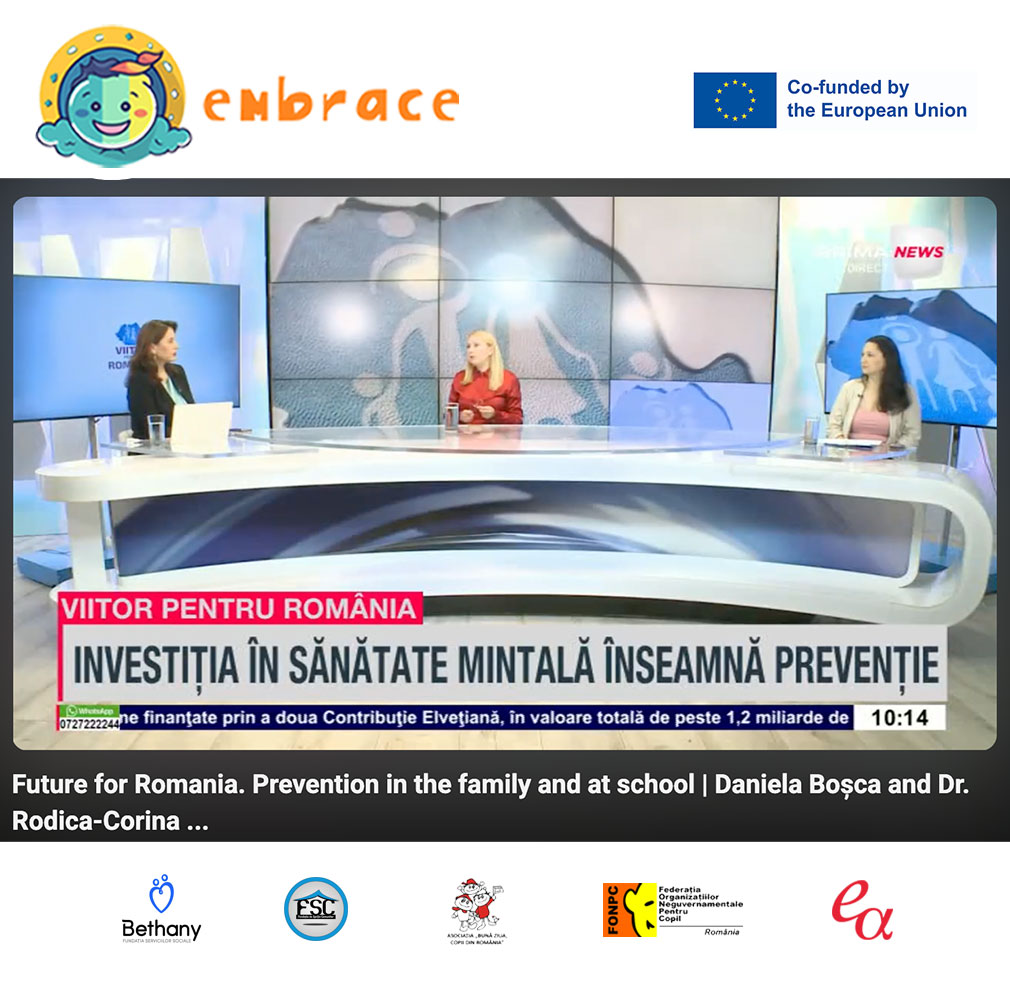
A truly resilient, supportive safety net for children and teenagers requires an intentional, structural shift in public policy away from responsive crisis intervention and directly toward sustainable, long-term prevention. This foundational philosophy took centre stage during a recent live national broadcast on Prima News, featuring Dr. Daniela Boșca, Executive Director of the Federatia Organizatiilor Neguvernamentale pentru Copil (FONPC), a partner in the EMBRACE project consortium, and educational sociologist Dr. Rodica-Corina Andrei.
Appearing on the specialised program segment “Viitor pentru România. Prevenția în familie și în școală” (Future for Romania: Prevention in the Family and at School), the experts provided an honest, data-driven analysis of the emotional realities and systemic adjustments currently facing youth mental health frameworks. Central to the discussion were the empirical findings of the latest impact study conducted under the EU CERV-funded EMBRACE project, which closely mapped the well-being needs of 500 students from three distinct counties in northeastern Romania: Bacău, Iași, and Vaslui.
The Five Interlocking Dimensions of Child Well-Being
The EMBRACE research model explicitly rejects the idea that mental health can be treated as an isolated clinical issue. Instead, the project measures and tracks child development through five distinct, holistic dimensions:
- Healthy Lifestyle: Examining physical behaviour, nutrition, sleep cycles, and physical activity.
- Cognitive Well-Being: Understanding study discipline, time management, and academic stress.
- Emotions: Developing emotional intelligence, self-awareness, and personal coping mechanisms.
- Spiritual Well-Being: Nurturing clear, foundational values and self-knowledge.
- Social Well-Being: Building healthy relationships, communication skills, and community connectivity.
The study revealed notable gaps between awareness and daily practice. While children frequently demonstrate a high general understanding of healthy behaviours, structural stressors like excessive screen time and a lack of study coherence continue to trigger high levels of anxiety, sadness, and burnout that closely mirror adult stress cycles. Over 60% of the surveyed students explicitly voiced a need for greater stability and structure in how they study, indicating that emotional exhaustion is impacting their daily routines.
Furthermore, the data strongly support shifting away from defensive anti-bullying actions and focusing instead on building protective, inclusive school environments. Schools must become systemic hubs that naturally prevent harmful behaviours from taking root, rather than simply scrambling to manage the fallout after an incident occurs.
Integrating the Home and Classroom: Operationalising the Toolkit
A key message from the interview was that children’s well-being cannot be separated into isolated areas. Their experiences at home, at school, and in relationships with others are closely connected. Supporting children, therefore, requires schools, families, and wider community services to work together – paying attention not only to learning, but also to emotional, social, and physical well-being.
To turn this ambitious policy goal into reality, the EMBRACE project consortium – spearheaded by Fundatia Serviciilor Sociale Bethany (Bethany), alongside Fundatia de Sprijin Comunitar (FSC), Asociatia Buna Ziua Copii din Romania (BZRO), Federatia Organizatiilor Neguvernamentale Pent (FONPC), and Evolutionary Archetypes Consulting SL (EAC) – has engineered fully validated, ready-to-use resources.
Crucially, these materials are designed to support educators without overloading them with administrative bureaucracy. As Dr. Daniela Boșca highlights, teachers are not psychologists, and they should not be expected to act as clinical counsellors. However, they do have a role to play in children’s well-being.
The EMBRACE toolkit, along with educational videos, can support teachers and parents on that journey.
A Call for Systemic Scaling and True Interdisciplinary Teams
As Daniela Boșca emphasised during the broadcast, non-governmental organisations excel at conducting grassroots needs assessments and building agile, field-tested models that work. However, the ultimate transition from temporary intervention to permanent societal change requires deep institutional cooperation and political will.
All EMBRACE tools, including complete validated teacher handbooks, accredited professional courses, and videos, are fully prepared to be handed over to public education authorities for national implementation. Schools cannot navigate the complexities of modern youth well-being alone. They must operate alongside parents’ associations, community groups, public health networks, and dedicated social workers who can bridge the gap between vulnerable households and the classroom.
By valuing the human element of education over mere academic metrics, we can replace rigidity with flexibility and ensure that every young person is given the emotional room and institutional security to construct a healthy future.
To watch the full expert broadcast on Prima News, visit the official link: Viitor pentru România on YouTube.
To explore, download, and utilise the project’s open-access prevention tools, visit: embrace-future.eu.
Funding Agency: EACEA – European Education and Culture Executive Agency
Learn more about EMBRACE: embrace-future.eu